
vOTE YES on
measure aa
The Excellence in Education Act (Measure AA) is a locally controlled funding measure that supports outstanding teachers, preserves arts and STEM programs, maintains small class sizes, and keeps Culver City schools among California’s best.
4,000+
Residents signed the petition.
100%
Funds stay in Culver City.
Independent
Citizen Oversight.
10 Years
Stable funding to support educational excellence in Culver City Unified School District.
endorsements
Stephanie Loredo, CCUSD Board President and candidate for re-election
Brian Guerrero, CCUSD Board Vice-President and candidate for re-election
Triston Ezidore, CCUSD Board Past President and candidate for re-election
Lindsay Carlson, CCUSD Board Parliamentarian
Andrew Lachman, CCUSD Board Clerk
Darrel Menthe, Candidate for CCUSD Board
Freddy Puza, Culver City Mayor
Bubba Fish, Vice-Mayor
Dan O’Brien, Council Member
Albert Vera, Council Member
Dr. Paul Karaiakoubian, Culver City Principal
Mr. Chris Medinger, Culver City Principal
Dr. Becky Godbey, Culver City Principal
Dr. Miguel (Mike) Perez, Culver City Principal
Dr. Adrienne Thomas Malveaux, Culver City Principal
Dr. Crystal Lane, Culver City Principal
Mr. Casey Chabola, Culver, City Principal
Mr. Ian McCullen, Culver City Principal
Mrs. Ilona Gergi, Culver City Director
The Los Angeles County Democratic Party
Los Angeles County Federation of Labor, AFL-CIO
Culver City Federation of Teachers
Culver City Democrats United
Culver City Democratic Club
Culver City Education Foundation
Association of Classified Employees - Culver City
Our Culver
Jeannine Wisnosky Stehlin, Candidate for City Council
Kimberley Griffin, Candidate for City Council
Thomas Aujero Small, Candidate for City Council
Franklin Carvajal, Candidate for City Council
Anne Allaire, Former CCUSD Board Member
Brian D. Lucas, Former CCUSD Superintendent
David Hauptman, Former Culver City Mayor
Steve Levin, Former CCUSD Board Member
Summer McBride, Former CCUSD Board Member
Alex Fisch, Former Council Member
Nancy Barba, Former Planning Commissioner
Jeanne Black, Vice Chair, Culver City Planning Commission
Jennifer Carter, Parent/Culver City Planning Commission Chair
Jeff Schwartz, Past President, Culver City Democratic Club
Dorien Davies, CCUSD Parent, volunteer, Children’s Television Producer
Mila Moraga-Holz, CCUSD Parent - Co-chair of Measure E and Measure O campaigns
Stephen Jones, Parent/Culver City Planning Commission Chair
Shane Henson, Vice Chair / Culver City Advisory Committee on Housing and Homelessness
Jenny Rogers, Aerospace engineer
Claudia Vizcarra, Schools supporter
John Low, Composer
Ji Young Denick, CCUSD Parent
Ross Piro, CCHS Parent
Mary Wehbi, Professor Emerita, SMC
Jon Dilworth, CCUSD Parent
Julie Hammons
Diana Hauptman
Gregory Maron
Johanna Gullick
Helen Keelan
Sameen Ahmadnia
Diane Wade, CCHS Parent
Matthew Polesetsky, Father of CCHS Student
Bronwyn Jamrok, CCUSD Parent
Heather Moses
Gregory Jamrok, Partner at Fine Line Music Service
Meta Valentic, Entertainment Industry Professional/ CCHS Parent
Kyle Valentic, Teacher
Amy Hee Kim, CCUSD Parent
Lindsay Schlatter, CCHS Parent
Kate Shirley CCUSD Parent
George Prior, CCUSD Parent
Gina Polesetsky, CCMS Speech & Debate Coach
Katy Krantz, Former Culver City Artist Laureate
Ippolytos Kalofonos, CCUSD Parent & CC Property Owner & Resident
Angie Graves, CCMS and La Ballona Garden Teacher, Parent
Thom Denick, CCUSD Parent
Dan Selz, CCUSD Parent
Rev Dr Frances Rosenau, Faith Leader
Stephanie Mesones Alvarado, CCUSD Parent, Measure O committee member
Dee Montealvo, CCMS Teacher, CCHS Parent, CCFT Site Rep, Labor-Management Partner
Seth Kotok, Parent
Marc Bauer, CCUSD Parent and Public Finance Professional
Disa Lindgren, Alum '79/Community Member
Michael Radparvar, CCUSD Parent
Claudia Vizcarra
Jessica Beagles-Roos
Eric & Beatriz Spies
ADD YOUR ENDORSEMENT
STRONG SCHOOLS BENEFIT THE ENTIRE COMMUNITY
STRONG SCHOOLS BENEFIT THE ENTIRE COMMUNITY
WHY excellence for culver city schools?

As parents and residents who care deeply about our kids and our city, we're inviting you to join us in a community movement to better support and strengthen our schools for the years ahead.
Declining enrollment, the loss of COVID-era funding, and significant federal education cuts, in addition to unusually high inflation, have combined to create serious financial challenges that threaten the quality of education our students deserve.
That’s why we’re exploring the idea of a sliding-scale parcel tax- a way for our community to raise stable, locally controlled funding that stays right here in Culver City, supporting our students directly. It’s worked for other California school districts, including Berkeley and Alameda, and we think it can work here too.
EFCCS Steering Committee
Amy Hee Kim
Anna Kosoff
Daniel Selz
Darrel Menthe
Ji Young Denick
Paul Zagala
Ross Piro
WHY THIS MEASURE?
California School Funding falls short
Despite one of the highest costs of living in the nation, the state spends roughly $18,000 per k-12 student- comparable to Delaware but far below New York’s $33,400 per student.
CCUSD has been facing ongoing financial DEFICITS.
Regular budget deficits have been temporarily masked by one-time COVID relief funds. The district is currently operating with a deficit of $4-5 million, placing all programs, services, and long-term sustainability at risk.
CUTS AND CROWDING LEAD TO DECLINING CONFIDENCE.
When resources run thin, every department feels the strain-staff and teacher morale decline, basic classroom needs such as supplies and photocopies are cut back, and larger class sizes limit the quality of instruction. The district risks losing public trust.
CCUSD is the backbone of culver city’s economy - AND IT’S SOMETHING WE CAN’T AFFORD TO LOSE.
These challenges push some families toward private schools, reducing average daily attendance and weakening the sense of community. Over time, the consequences extend beyond the classroom - threatening the district’s long-term stability, community engagement, and even local property values.
stable and predictable funding
Unlike state or federal funding, which can fluctuate based on budgets and economic and political conditions, sliding-scale parcel taxes provide consistent, locally controlled revenue. This stability can help CCUSD plan long-term programs and staffing with more confidence.
EVERY DOLLAR STAYS IN CULVER CITY
Sliding-scale parcel tax funds are locally generated and locally governed, meaning the CCUSD decides how to use them. Potential uses include:
Maintaining or reducing class sizes
Retaining high-quality teachers and staff
Enhancing technology and safety
Supporting art, music, and enrichment programs
Funding extracurricular or special education programs
community investment for our future
Passing a sliding-scale parcel tax that benefits CCUSD can signal that the community values education and is willing to invest in its future. This can strengthen local engagement and even enhance property values, since high-performing schools are a major factor in neighborhood desirability.
THIS MEASURE HELPS PROTECT
✳︎
EXCELLENT TEACHERS
✳︎
HIGH-QUALITY NEIGHBORHOOD SCHOOLS
✳︎
STUDENT OPPORTUNITIES
✳︎
STRONG PROPERTY VALUES
✳︎
THIS MEASURE HELPS PROTECT ✳︎ EXCELLENT TEACHERS ✳︎ HIGH-QUALITY NEIGHBORHOOD SCHOOLS ✳︎ STUDENT OPPORTUNITIES ✳︎ STRONG PROPERTY VALUES ✳︎
MYTH VS. FACT

Myth
Schools should just spend better.
fact
CCUSD has already reduced spending significantly and still faces structural funding challenges.
myth
Sacramento can take this money.
fact
Funds stay local.
MYTH
There is no oversight.
fact
Independent citizen oversight is built into the measure.
myth
This only benefits families with children.
fact
Strong public schools increase home values, attract families, strengthen neighborhoods, and benefit the entire community.
Culver City Public schools excellence in Education act of 2026
BE THE CHANGE
ways to get involved 01: volunteer
Excellence for Culver City Schools is a grassroots initiative organized by parents and residents who care deeply about the future of our schools and our community. We invite all community members to join us in making a lasting impact on Culver City’s future.
ways to get involved 02: DONATE
We need to raise funds to support our campaign for the November election. Every contribution-no matter the amount-will be used strategically to ensure the success of our campaign. We sincerely thank you in advance for your generous support.


WHAT’S NEXT?
iNITIATIVE DRAFTED - DONE!
4,000+ SIGNATURES COLLECTED - DONE!
QUALIFIED FOR NOVEMBER BALLOT - DONE!
CAMPAIGNING FOR THE ELECTION DAY - WE ARE HERE!

SUCCESS STORY
Berkeley Unified School District (BUSD)
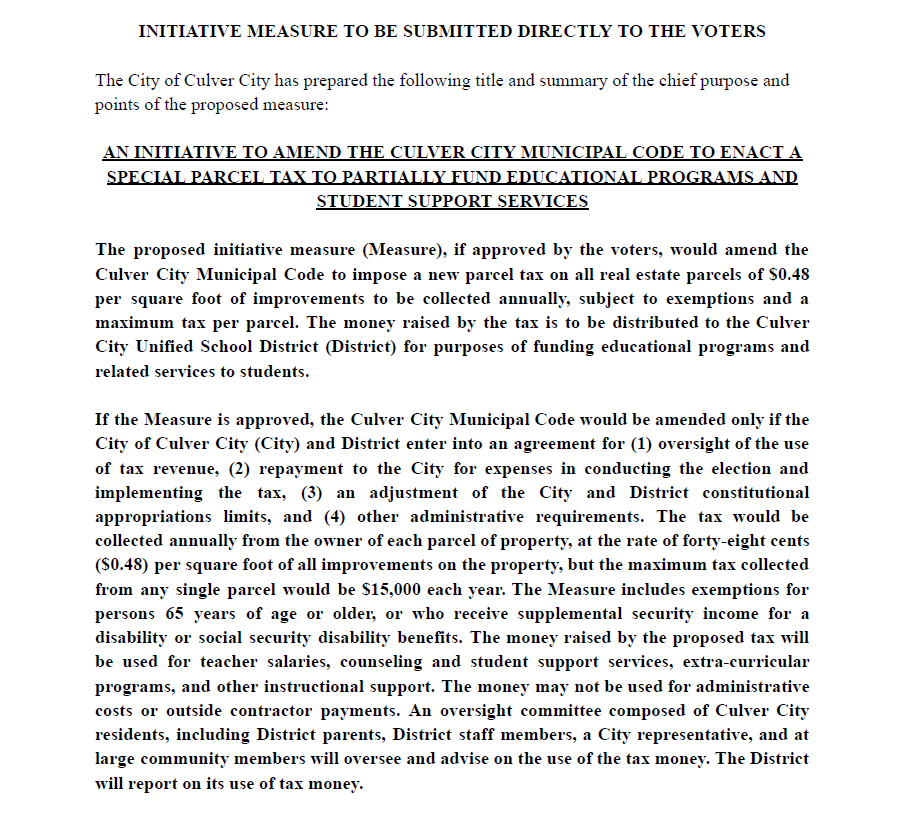
BUSD placed Measure H on the ballot for renewal: a special parcel tax at the rate of $0.54 per square foot of improvements, plus $25 per unimproved parcel, for 8 years beginning July 1, 2025.
The measure states that funds will be used for instruction (class size support, teaching/learning), school programs (libraries, visual & performing arts), and student support (counseling, behavioral health).
The district’s page on local bond & tax funding explains that the community supports “much-needed resources to augment the relatively low level of state funding.”
Your Questions, Answered
-
A group of citizens has drafted this language and connected with the City of Culver City and the County of Los Angeles to determine the process and procedure. The will go on the ballot if we can secure the required number of signatures, which is 10% of the total number of registered voters in Culver City. We are aiming for about 40% more than that total, about 4,000 signatures total. That is a best practice in initiatives, to ensure that we have enough valid signatures when checked accounting for possible duplicates or people who are not registered to vote in Culver City.
-
Recent court cases have determined that if the citizens use their constitutional initiative power to propose a statute, including a tax, the measure will become law if passed by a simple majority of voters (50%+1). It will also require a campaign in the fall. Be part of it!
-
No. Every dollar raised by this measure will be used for Culver City schools, and none of it can be taken away by the county, state, or federal government.
-
Measure K was passed in 2018 and is a flat tax of $189 per parcel. That was continued in 2024 as “Measure O” at the same rate – so just a single flat rate parcel tax has been enacted in Culver City. The Measure K/O parcel tax is just that, a flat tax per parcel, or address. Whether you were a giant, several hundred thousand square foot studio or a small condominium, you paid the same amount. This does not seem remotely fair to us.
So building on pioneering efforts in Berkeley and Alameda, we are proposing a “sliding” scale parcel tax on the size of the property improvements (aka the building on the parcel), according to the Los Angeles County Assessor Portal https://portal.assessor.lacounty.gov/. This means that larger corporate owners or bigger homes will pay more, while smaller homeowners will pay less. Whether it is called “sliding” scale or “progressive” the point is that this is the first time Culver City will move beyond a flat tax for additional local school funding.
While Measure K/O brings in just $2.4M, the citizen’s initiative is a game changer that will bring in $18M, more than enough to close the structural deficit and provide substantial new opportunities for educational programs and all the priorities listed in the measure.
-
We are a group of Culver City citizens, parents with children in Culver City Unified School District (CCUSD) who are committed to ensuring that our students receive a high-quality education in a safe and supportive environment and that our city remains a highly desirable place to live and work, with above market property values. Many of us chose to live in Culver City specifically because of its strong public schools. This initiative reflects our shared commitment to protecting and strengthening that foundation for current and future families.
We are supported by the Culver City Federation of Teachers. The Steering Committee names are listed on the “About” page, but many more parents are involved who are not listed!
-
You might be thinking of what was originally called Measure K, which approved a flat tax of $189 per parcel. It was originally approved by Culver City voters in 2018 and was set to expire in 2026, until Measure O was placed on the 2024 ballot to continue the same $189 flat parcel tax. That passed overwhelmingly with over 82% support and is set to continue for 8 more years until 2034. The proposed initiative is not able to repeal the existing flat parcel tax, which brings in only about $2.4 million, but we believe our initiative will make it obsolete. There will be no need to renew the Measure K/O a third time.
-
As part of our ballot measure, the District shall establish and appoint a Planning and Oversight Committee composed of Culver City Unified School District parents/guardians, staff members, Culver City residents, and community members representing all school sites.
We have heard concerns raised by other parents about oversight. We have worked hard and thought carefully to make sure this committee is more effective than many oversight committees, crucially by making sure the committee can proactively delivers its recommended annual spending plan to the district before funds are allocated in a specific year (rather than merely rubber stamping approval once funds have been allocated), to allow maximum opportunity and flexibility for the district to implement these preferences and recommendations.
This is a balanced approach where the Planning and Oversight Committee both does advance planning and oversight, yet the District retains its legal authority on spending decisions.
-
While our goal is not to relitigate the past, the reality that may surprise many people is, whatever you may have thought of past school boards or administration, the senior cabinet are all new since 2024 and the current school board was elected only in 2022 and 2024. While earlier decisions have impacted the reserves and caused impacts on the current budget, the larger issue of state under-funding of education and the current structural deficit are bigger issues that require a new response. This citizen’s initiative addresses that bigger picture.
The school board and district will play a key role in how the funds are used. So showing up in November is important, not just to vote for this sliding scale parcel tax, but to vote for three of the five school board seats that will be up for election in 2026.
But beyond that, this is why we view our effort as so critical in the long term health of schools and our communities. Because we’re not just gathering 4000 signatures. We are aiming to build a ‘standing army’ if you will of 4000 informed and activated parents and citizens who are saying, ‘we’re gonna get to the bottom of how our schools are spending their money, we’re gonna stay informed, and if the school board doesn’t listen to us or make good faith efforts to follow the spending priorities of our community’, we’re prepared to vote them out.
So please, even if you’re still unsure about this initiative, click our sign up form to make sure you can get our newsletter and volunteer for the “Would you like to help with school budget review/advising?” opportunity.
-
Yes. Seniors may apply for an exemption from this citizen’s initiative parcel tax just as they currently can from Measure O. The citizen’s initiative actually expands that exemption to include ADUs occupied by seniors.
A homeowner may apply to exclude the ADU square footage from the taxable total if it is occupied by a senior who would otherwise be entitled to an exemption if it were a separate parcel.
-
November 3, 2026.
-
Under the California Elections Code, there is no direct way for school district residents to organize an initiative without the participation of a municipal government. In this case, the City of Culver City will collect the funds in a separate account, then turn them over to the school district. The initiative asks the City and the District to work out an implementation agreement so that this can happen smoothly. It also will require the District to bear the election costs if the initiative succeeds on the ballot.
-
No. The citizen’s initiative does not restrict spending in this manner. Funds raised through the measure can be spent on existing programming and can be budgeted to replace existing general fund spending. A balanced approach sets forth goals but does not tie the hands of the district in meeting financial and educational needs.
Why $0.48c per square foot?
This is a great and important question! While there is no perfect answer to the question of what’s the ‘right size’ amount, we thought long, hard, and deeply about this question and there are several reasons for why we believe this rate is a balanced approach:
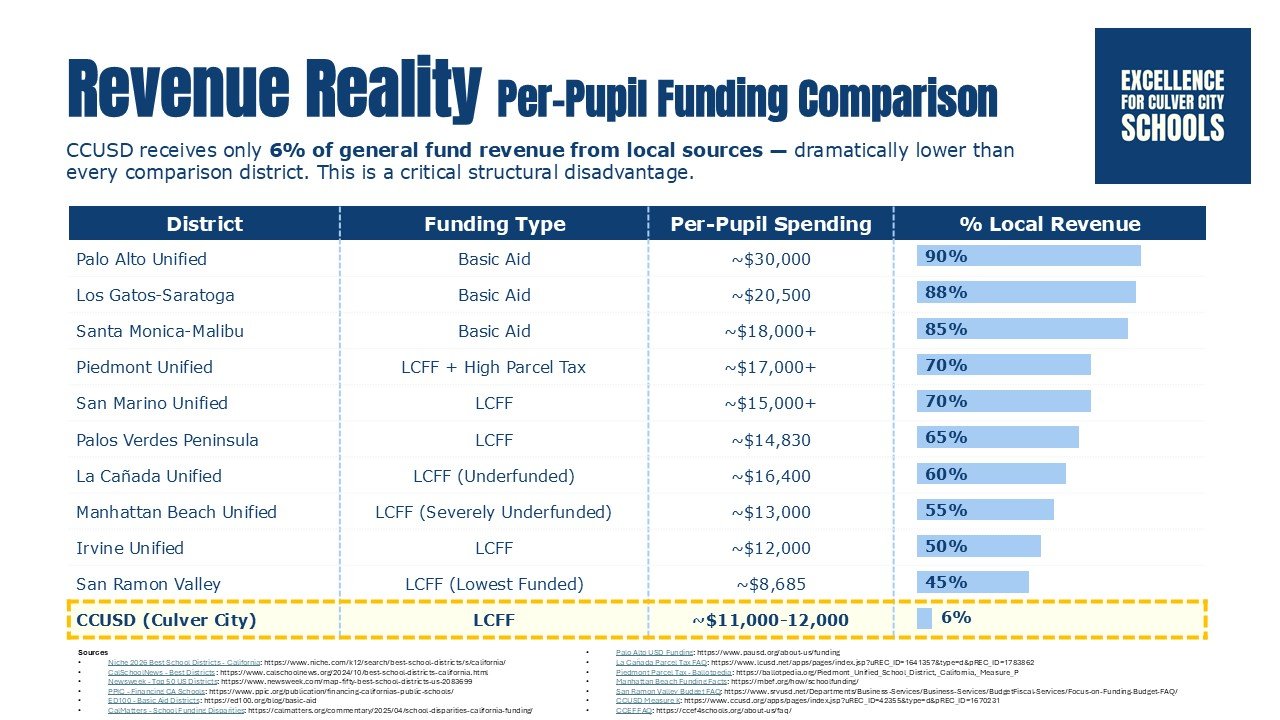
1) Our Schools Are Underfunded and specifically, they are underfunded with respect to the amount of local funding they are receiving, Check out this chart compiled by one of our parent volunteers with a little help from ChatGPT and publicly available data:
2) In keeping with best practices. $0.48 is in line with, but actually less than other ‘sliding scale parcel taxes’ that we based our efforts on in California, specifically in Berkeley and Alameda Counties. It’s worth noting that these communities have higher parcel tax rates, with Berkeley’s being currently set at $0.54 per square foot of improvement (building). We initially explored just benchmarking totally against Berkeley’s number, but felt we didn’t need to go that high to achieve excellent results. We believe this is a balanced tax rate the community can reasonably support while still achieving our goals.
3) Going from scarcity to abundance. Even after making a significant round of cuts, our school district still faces a $6M structural budget deficit, with possible draconian consequences including cuts to beloved programs ranging from PE to art to music to innovation, not to mention loss of local control over schools (we risk essentially going into receivership and having the state take over control of our schools).
Obviously, at a minimum we need to make sure this never happens and we can replenish our reserves. However, doesn’t our community deserve more than just avoiding the worst possible fate? Can’t we aim higher than that?
We believe we can (hence the name of our group) and so we wanted to set an aspirational goal of not just eliminating the downside but having the money to create a truly extraordinary environment for our kids–the $0.48 would result in an estimated $18 million which, is $6M to eliminate the deficit and then 12M or twice that to help our schools flourish.
4) Replenishing our reserves: One thing that was also important in driving our thinking was that, in addition to avoiding further cuts, and allowing for more growth (per points 1 and 3 above), we also needed to replenish our reserves which have reached dangerously low levels. Recently our reserves have dropped to less than 1% of the general fund budget, following changes to the state budget and the expiration of one-time COVID relief funds. At a minimum, we need to be at the 3% of the general fund budget or we risk falling into negative certification, which means we could lose its autonomy, and a state-appointed trustee will oversee our district's operations — the trustee will have veto power over new contracts and other decisions that the school board makes.
Do you have a question you don’t see listed here? Please email us at efccs2026@gmail.com and we’ll do our best to answer as transparently and honestly as possible. (Please bear in mind we are an all-volunteer group with full time jobs and collectively about a bajillion kids as well, so we may be a little delayed in getting back to you)
DEAR CULVER CITY:
The Myths and Facts of Public School Funding
This recent piece from Culver Crescent breaks down the biggest myths vs. realities of public school funding in Culver City—and the truth may surprise you. It challenges common assumptions (like “we keep funding schools but nothing improves”) and explains how state funding formulas, local taxes, and rising costs actually shape what schools can and can’t do.
If you care about local education, taxes, or community decisions, this article gives you the clear, fact-based context needed to understand what’s really going on—and why future funding votes matter more than ever.
STAY INFORMED ABOUT OUR PROGRESS
Sign up for our newsletter to receive updates and stay connected.